
The Fast-Moving System Behind a Food Truck Operation
How food trucks in Houston use mobility, speed, and connected technology to improve order flow, service efficiency, and guest convenience.
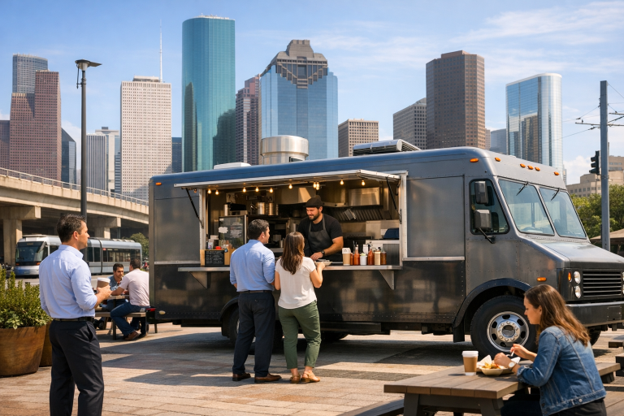
A food truck may look simple from the customer side: guests line up, place an order, and receive food from a compact kitchen just a few feet away. In reality, strong food truck operations depend on tight coordination between ordering, cooking, packaging, payments, and customer communication, all within a very limited space.
Unlike many fixed-location restaurants, food trucks must balance fast service with constant movement, changing locations, unpredictable connectivity, and event-driven demand. That is especially relevant in the Houston food truck market, where a diverse culinary scene, a strong event culture, and growing demand for food truck catering create both opportunities and operational complexity. For operators trying to stand out in local search, terms such as Houston food truck catering, corporate food trucks in Houston, food truck events in Houston TX, Downtown Houston food truck catering, and Midtown Houston food truck service align closely with how customers often look for mobile food service options. Current food truck industry coverage continues to emphasize the importance of mobile POS systems, online ordering, contactless payments, and integrated kitchen workflows for keeping lines moving and reducing service friction.
1. Speed Starts at the Order Window
In a food truck, the first bottleneck usually happens where the customer orders. Long lines, repeated questions, unclear modifiers, and slow payment processing can stall the entire operation. Because trucks often serve in bursts at lunch stops, festivals, and community events, speed at the order window matters even more. Mobile-friendly POS systems, contactless payments, and QR-based ordering can reduce line pressure and help staff capture orders more accurately.
2. The Kitchen Has to Work in a Very Small Footprint
A food truck kitchen has less room, less storage, and less margin for error than a traditional restaurant. Prep stations, cooking equipment, assembly space, and packaging all compete for the same limited area. That means every movement matters. Food truck operators need streamlined prep, simple menu execution, and clear ticket flow so staff can produce orders quickly without chaos. The objective is not only speed, but consistency under pressure in a compact mobile environment.
3. Visibility Keeps Lines Moving
During peak periods, food truck staff need a clear view of what has been ordered, what is being prepared, and what is ready for pickup. That visibility becomes even more important when orders arrive from multiple sources such as the window, online ordering, or QR code menus. Kitchen display systems and simplified digital ticket management help reduce missed items, improve timing, and keep the team aligned even when demand spikes suddenly.
4. Pickup and Handoff Need to Stay Accurate
In a busy food truck, speed means very little if the wrong order reaches the wrong customer. Packaging, order calling, labeling, and pickup timing all affect service quality. This becomes even harder at crowded events or when customers order ahead. Clear handoff processes help prevent confusion, reduce remakes, and maintain a better customer experience when the truck is operating at full pace.
5. Mobility Changes the Entire Workflow
Food trucks do not operate from one fixed environment. They move between office parks, festivals, private events, and street service locations, often with different demand patterns and connectivity conditions. That makes flexibility essential. Operators benefit from systems that support mobile payments, offline functionality, digital menus, route-based selling, and quick menu updates. When technology adapts to mobility, the truck can serve more customers without adding unnecessary friction.
The Technology That Keeps a Food Truck Moving
Technology plays a central role in food truck performance because it connects mobility with control. Modern food truck operators increasingly rely on lightweight POS systems, contactless payments, QR ordering, online ordering, and cloud-based reporting to manage service more effectively. Industry coverage in 2026 also highlights the importance of offline capability, compact hardware, real-time sales visibility, and integrated kitchen workflows for reducing delays and improving service consistency.
Food truck operators often need more than a simple card reader. They need connected tools for order taking, kitchen visibility, mobile payments, online ordering, menu updates, customer communication, and reporting across different service locations. The right technology setup helps a truck move faster, reduce mistakes, and make better operating decisions from one stop to the next.
Conclusion
A successful food truck depends on flow. From order capture and compact kitchen execution to pickup, payments, and mobility between service locations, every part of the operation has to move efficiently. With the right systems in place, food truck operators can improve speed, reduce errors, support staff efficiency, and deliver a better customer experience wherever they serve.
If your Houston food truck is looking to improve line speed, simplify mobile ordering, and build a more connected operation from ordering through handoff, our team can help. From Downtown Houston office lunches to Midtown events and neighborhood activations, we help food truck operators build practical technology environments that fit the way they work and support stronger visibility in local Houston searches.
Contact us to learn how practical restaurant technology solutions can improve speed, visibility, accuracy, and day-to-day operational control for your Houston food truck.